We work alongside iwi to assist in their mana whenua aspirations and provide technical support for environmental management, ecosystem restoration and economic development.
Our partnerships are key in all Aotearoa New Zealand impact project ventures.
Our current work in T?kapa Moana Hauraki Gulf is alongside the Ng?i Tai ki T?maki iwi and Ng?ti P?kenga with the goal of restoring the mauri, or lifeforce, of the marine environment using regenerative ocean farming of seaweed.
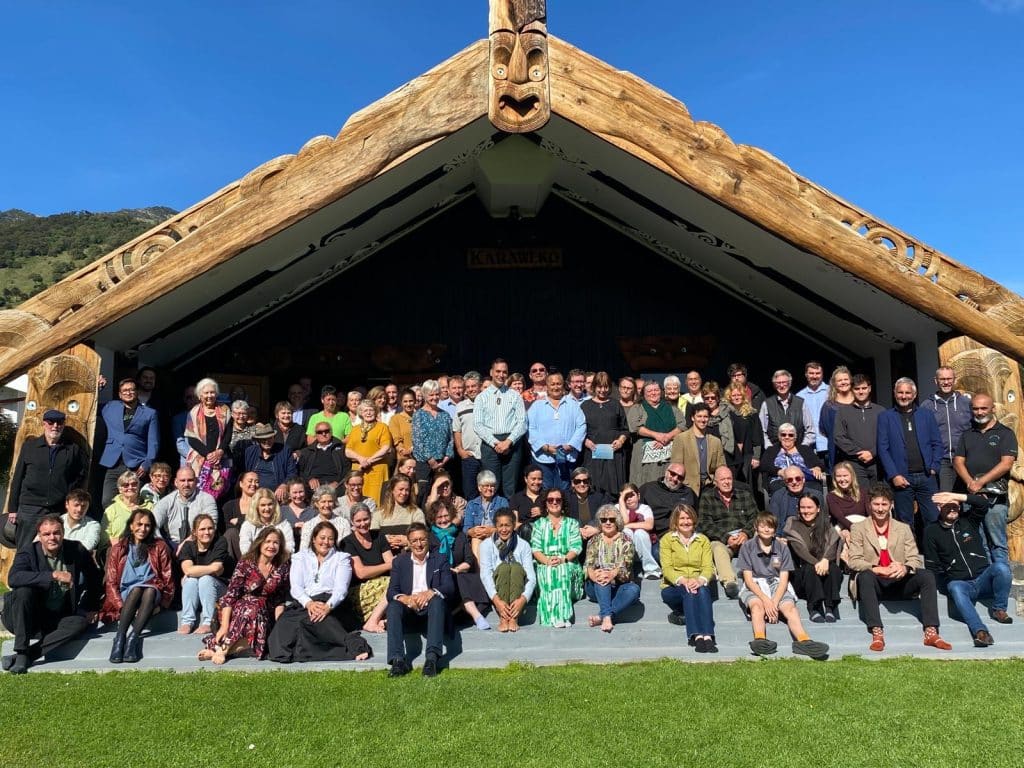
A powerful call to action in restoration rather than extraction was shared with more than 100 community and political leaders at the Te Kori a te Kō Nature Symposium in Akaroa on New Zealand’s South Island. Opening the event held by Onuku Runanga at Akaroa marae, Runanga Chair Rik Tainui shared the 200-year vision guiding action to restore the mauri of Akaroa harbour and create pathways for ecological repair and local jobs – including through regenerative seaweed farming. Home to generations of whanau and of immense significance to Ngai Tahu, Onuku was the site where the Treaty of Waitangi was…
EnviroStrat successfully led the response of New Zealand’s largest tribe to a proposal for deep sea phosphate mining on the Chatham Rise, NZ. Developed and executed a strategy to refute the evidence presented by the applicant through a 3 month hearing process, including engaging and managing experts in economics, ecology, ecotoxicology, planning, and international best practice. There were a number of unresolved issues, including the impact on existing fisheries and cultural interests, the need for adaptive management in the context of very large infrastructure development, restoration techniques using the precautionary principle, and the reliance of modelling as a proxy for…
EnviroStrat prepared the Investment Case for an open ocean 1,200 ha Mussel Spat Farm off 90 Mile Beach for three far north tribes and the aquaculture sector to address a critical risk to future growth of the mussel sector. EnviroStrat worked with the three tribes, industry, stakeholders, and MPI, as well as potential investors throughout the process. The investment case involved strategic assessment, consideration of social, environmental, cultural and economic factors, detailed financial modelling, legal analysis and engineering design.
EnviroStrat was engaged by Te Runanga o Ng?i Tahu to prepare a restoration strategy for Te Waihora and surrounding catchment, as current approaches that rely on government grants are not having the required impact on the highly impacted estuarine lake and catchment. EnviroStrat identified innovative approaches to monetising and scaling restoration through payment for ecosystem services including carbon forestry, trialling blue carbon within the lake, use of freshwater / brackish macroalgae for nutrient removal, wetland creation for both water quality and biodiversity impact, as well as environmental impact investment.