

We’re partnering with GreenWave in the United States to adapt its highly successful
regenerative ocean farming model for New Zealand.
An innovative three-year
seaweed farming pilot
Founded by Dr Nigel Bradly with a vision to restore the mauri — life force and vitality — of Aotearoa New Zealand’s oceans and coastal communities, Greenwave Aotearoa is dedicated to advancing regenerative ocean farming. By combining traditional knowledge with innovative marine science, Greenwave Aotearoa cultivates scalable seaweed farming initiatives that strengthen local ecosystems, promote sustainable livelihoods, and support climate resilience.
Our team of experts includes leaders in marine biology, aquaculture, community engagement, and impact project management. Together, we are advancing a new model for ocean farming that creates opportunities for economic development while ensuring the health and restoration of our marine environments.
Prior to Greenwave Aotearoa, a functional supply chain for the seaweed sector in New Zealand was missing; constraining the development and growth of the sector.
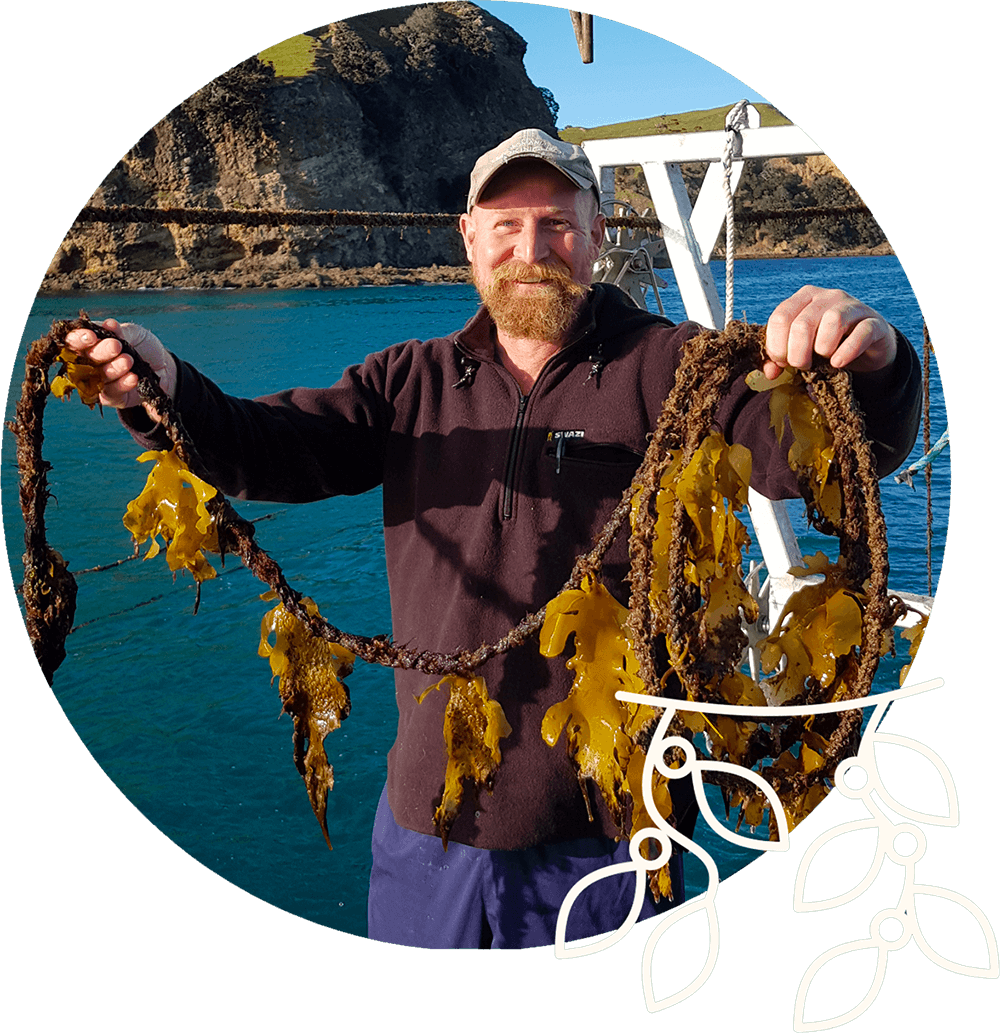
Greenwave Aotearoa’s team has developed and continues to test hatchery, farming, harvesting and farm designs for our local seaweed species and conditions. With guidance from GreenWave USA we developed, and are implementing, a plan to establish and optimise an end-to-end seaweed supply chain that enables the growth of a new high-value sector for New Zealand.
Find out more at www.greenwave.nz
Maximising our impact
through collaboration
The GreenWave Aotearoa pilot is led by EnviroStrat, in collaboration with a network of partners.

Lucas Evans from Premium Seas is facilitating access to water space and providing operational oversight for the pilot delivery in Coromandel.

Ngāi Tai ki Tāmaki are providing additional recently consented marine farming space to support the pilot.

University of Waikato researchers Dr Marie Magnusson and Dr Rebecca Lawton oversaw the pilot project research and trial design.

Professor Andrew Jeffs at University of Auckland is leading monitoring to establish the biodiversity impacts of co-locating mussels and seaweed farming.

AgriSea are contributing their post-harvest production, market and processing expertise and have agreed to purchase all product for the duration of the pilot.
Pilot Timeline
2022-09-01
Early 2019
EnviroStrat connected with GreenWave and started a discussion about how to adapt its model for New Zealand.
2022-09-02
Mid - late 2019
Feasibility study exploring whether the GreenWave model could work in New Zealand.
2022-09-03
Early - mid 2020
Developed a detailed investment case to support the establishment of regenerative ocean farming in New Zealand. The investment case also identified that a multi-year pilot to confirm productivity (and therefore financial viability) of seaweed farming was a required first step.
2022-09-04
Mid 2020 - mid 2021
Secured funding and partnerships to
implement the pilot.
2022-09-05
August 2021 - mid 2022
Stage 1 – Can we grow seaweed on
lines?
Establish the best farm line configuration
2022-09-06
Mid 2022 - mid 2023
Stage 2 – Can we grow seaweed from
spores?
Optimise hatchery conditions, outplanting logistics and determine the best time to outplant
2022-09-07
September 2022
First outplanting at scale of hatchery
grown Ecklonia radiata seaweed
CURRENT STAGE
2022-09-08
Mid 2023 - end 2024
Stage 3 – Can we grow at
commercial scale?
Refine farming logistics and model assumptions at scale
Want to stay up to date with GreenWave Aotearoa’s progress?
Join our mailing list to receive updates from the GreenWave Aotearoa pilot as we achieve new milestones.
Seaweed’s huge potential to be a game changer for Aotearoa New Zealand’s blue economy.
Seaweed is the fundamental crop for the regenerative ocean farming model. While numerous initiatives and businesses are targeting seaweed as a novel primary resource for the blue economy, the New Zealand sector is currently operating at a small scale. Gaps in reliable supply and barriers, including legislative and operational, limit the sector’s ability to grow.
A prosperous seaweed sector could provide meaningful economic, environmental, social and cultural benefits to local communities, along with broader impacts nationally. Our philosophy is not just finding a new way to grow seaweed, but focusing a lens on an environmental problem that we can help solve, while creating economic opportunity.
Our funding partners
EnviroStrat, along with the Sustainable Food and Fibre Futures fund (SFFF), administered by the Ministry for Primary Industries, impact investors and philanthropists have contributed to funding. Early contributions were received from Auckland Council, Bay Trust, Foundation North, The Tindall Foundation and Akina.